Contents
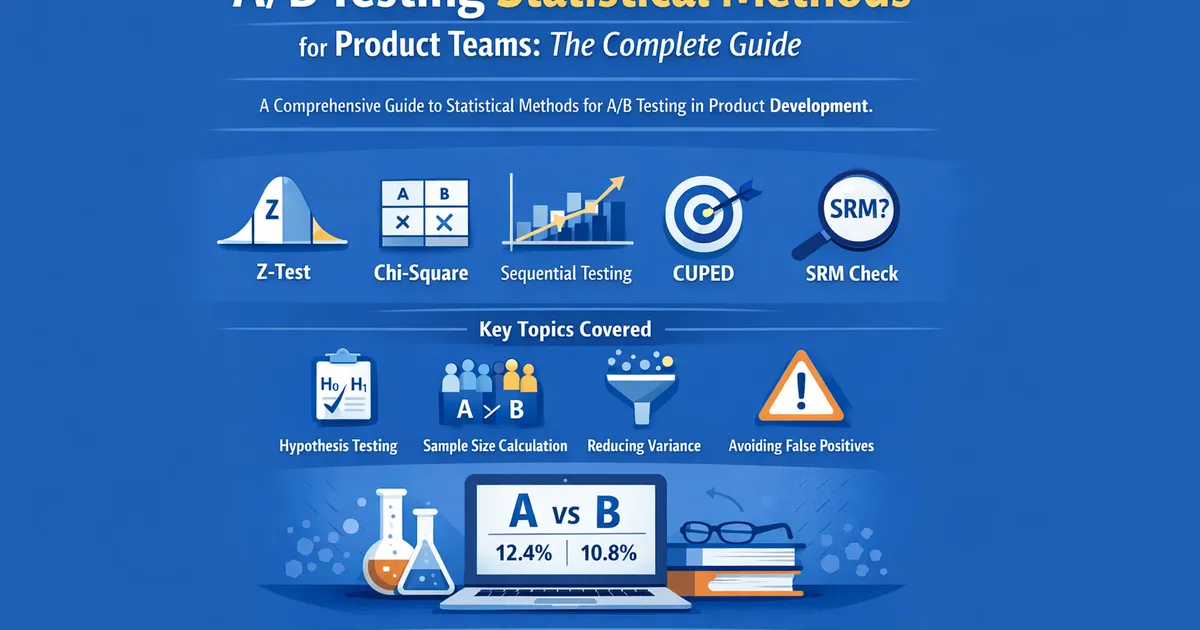
A/B Testing Statistical Methods for Product Teams: The Complete Guide
A comprehensive guide to statistical methods for A/B testing in product development. Learn when to use z-tests, chi-square, sequential testing, CUPED, and how to handle the real-world messiness of experimentation.
Quick Hits
- •Most A/B tests don't need fancy methods—a simple two-proportion z-test handles 80% of conversion rate experiments
- •Peeking at results without sequential testing inflates your false positive rate from 5% to 20-30%
- •CUPED can reduce required sample size by 50%+ when you have strong pre-experiment covariates
- •Sample ratio mismatch (SRM) is the canary in the coal mine—always check it before trusting results
TL;DR
A/B testing is deceptively simple in concept but statistically treacherous in practice. This guide covers the statistical methods product teams actually need: from basic hypothesis tests to variance reduction techniques, from handling peeking to dealing with clustered data. The core message: match your statistical method to your actual problem, pre-register your analysis plan, and resist the temptation to torture data until it confesses.
The Statistical Foundation of A/B Testing
Every A/B test is fundamentally a hypothesis test. You're asking: "Is the difference I observe between control and treatment larger than what I'd expect from random chance alone?"
The null hypothesis (H₀) states there's no real difference—any observed gap is just noise. The alternative hypothesis (H₁) says there is a real effect. Your statistical test calculates the probability of seeing your observed data (or something more extreme) if H₀ were true. That probability is the p-value.
A p-value below your significance threshold (typically α = 0.05) means you reject the null hypothesis. But here's what that actually means: if there truly were no effect, you'd see a result this extreme less than 5% of the time. It does not mean there's a 95% chance the effect is real.
The Two Errors You Can Make
Type I Error (False Positive): Declaring a winner when there's no real difference. Your significance level α controls this—setting α = 0.05 means you accept a 5% false positive rate.
Type II Error (False Negative): Missing a real effect. Statistical power (1 - β) is your protection here. Power of 80% means you'll detect a real effect 80% of the time it exists.
These trade off against each other. Want fewer false positives? Demand stronger evidence (lower α), but you'll miss more real effects. Want to catch every real effect? You'll also catch more ghosts.
Effect Size: The Forgotten Third Pillar
Statistical significance tells you whether an effect exists. Effect size tells you whether it matters. A test with millions of users can detect a 0.01% lift as "significant"—but if that lift means $47 annually, who cares?
Always report and interpret effect sizes alongside p-values. For conversion rates, this typically means absolute or relative lift with confidence intervals. A result of "conversion increased from 4.2% to 4.5% (95% CI: 0.1% to 0.5%, )" tells a complete story. "" alone tells almost nothing.
Choosing the Right Statistical Test
The test you use depends on your metric type, sample size, and data characteristics. Here's the decision framework.
Binary Metrics (Conversion Rates)
For conversion rates and other binary outcomes (clicked/didn't click, purchased/didn't purchase), you have three main options:
Two-Proportion Z-Test: The workhorse of conversion rate testing. Assumes large samples (generally n > 30 per group with at least 5 successes and failures). Uses the normal approximation to the binomial distribution.
from statsmodels.stats.proportion import proportions_ztest

# Control: 500 conversions out of 10,000
# Treatment: 550 conversions out of 10,000
count = [500, 550]
nobs = [10000, 10000]

stat, pvalue = proportions_ztest(count, nobs, alternative='two-sided')
print(f"Z-statistic: {stat:.3f}, P-value: {pvalue:.4f}")
Chi-Square Test: Mathematically equivalent to the z-test for two groups (), but extends naturally to comparing more than two variants. Use this when you're testing multiple treatments simultaneously.
Fisher's Exact Test: For small samples where the normal approximation breaks down. If you have fewer than ~1,000 users per group or very low conversion rates (< 1%), Fisher's exact test gives accurate p-values where the z-test and chi-square may not.
from scipy.stats import fisher_exact

# Small sample: 15 conversions out of 200 (control) vs 25 out of 200 (treatment)
table = [[15, 185], [25, 175]]
odds_ratio, pvalue = fisher_exact(table)
print(f"Odds ratio: {odds_ratio:.3f}, P-value: {pvalue:.4f}")
Decision Rule: Use z-test for most conversion rate experiments with reasonable sample sizes. Use Fisher's exact when sample sizes are small or rates are extreme. Use chi-square when comparing 3+ variants.
For a deeper dive on selecting between these tests, see Choosing the Right Test for Conversion Rates.
Continuous Metrics (Revenue, Time on Site)
Continuous metrics require different approaches:
Welch's T-Test: The default for comparing means between two groups. Unlike Student's t-test, Welch's doesn't assume equal variances—and variances are almost never equal in practice. There's no reason to use Student's t-test anymore.
from scipy.stats import ttest_ind

control_values = [...]  # revenue per user in control
treatment_values = [...]  # revenue per user in treatment

stat, pvalue = ttest_ind(control_values, treatment_values, equal_var=False)
Mann-Whitney U Test: When your continuous metric is heavily skewed (like revenue with its long tail of whales), the t-test's assumption of approximate normality may not hold even with large samples. Mann-Whitney tests whether one group tends to have larger values than the other, without assuming any particular distribution.
But beware: Mann-Whitney doesn't test whether means differ. It tests stochastic dominance—whether a randomly selected treatment user tends to have a higher value than a randomly selected control user. This is a subtly different question.
Bootstrap Methods: For complex metrics or when you want confidence intervals without distributional assumptions, bootstrap resampling is your friend. Resample your data with replacement thousands of times, compute your statistic each time, and use the distribution of results for inference.
import numpy as np

def bootstrap_mean_diff(control, treatment, n_bootstrap=10000):
    diffs = []
    for _ in range(n_bootstrap):
        c_sample = np.random.choice(control, size=len(control), replace=True)
        t_sample = np.random.choice(treatment, size=len(treatment), replace=True)
        diffs.append(np.mean(t_sample) - np.mean(c_sample))

    ci_lower = np.percentile(diffs, 2.5)
    ci_upper = np.percentile(diffs, 97.5)
    return ci_lower, ci_upper
For metrics that don't behave nicely, see Non-Normal Metrics: Bootstrap, Mann-Whitney, and Log Transforms.
Count and Rate Metrics
Sessions per user, events per session, purchases per visitor—these are counts or rates that need special handling:
Poisson Test: For comparing event counts when the Poisson assumption (variance equals mean) approximately holds.
Negative Binomial: When counts show overdispersion (variance > mean), which is common with behavioral data. Users aren't identical—some are highly engaged, others barely active—leading to more variance than Poisson predicts.
Rate Ratios: For events-per-time metrics, model the rate directly using Poisson regression or compare rates using methods designed for incidence rate ratios.
Sample Size and Power Analysis
Running an underpowered test is worse than not running one at all. You'll likely get a null result, but you won't know if there's truly no effect or if you just didn't have enough data to detect one.
The Power Calculation
Power depends on four quantities:
- Baseline rate: Your current conversion rate (or mean)
- Minimum detectable effect (MDE): The smallest effect you'd want to detect
- Significance level (α): Usually 0.05
- Power (1-β): Usually 0.80
Given any three, you can calculate the fourth. Most commonly, you fix α, power, and MDE, then solve for required sample size.
from statsmodels.stats.power import NormalIndPower

# For a proportion test
from statsmodels.stats.proportion import proportion_effectsize

baseline = 0.05  # 5% baseline conversion
mde = 0.005  # detect 10% relative lift (0.5 percentage points)

effect_size = proportion_effectsize(baseline, baseline + mde)
analysis = NormalIndPower()
sample_size = analysis.solve_power(
    effect_size=effect_size,
    alpha=0.05,
    power=0.80,
    alternative='two-sided'
)
print(f"Required sample per group: {sample_size:.0f}")
Minimum Detectable Effect: The Real Constraint
Sample size and MDE are inversely related (quadratically—halving your MDE requires 4x the sample). In practice, your traffic volume is fixed, which determines your MDE.
Before starting any test, calculate: "Given my traffic over the test duration, what's the smallest effect I can reliably detect?" If that MDE is larger than any plausible effect of your change, don't run the test. Either find a higher-traffic page, extend duration, or accept that this isn't testable.
For a complete guide to this calculation, see MDE and Sample Size: A Practical Guide.
The Variance Reduction Revolution
What if you could effectively increase your sample size without waiting longer? Variance reduction techniques do exactly this by using pre-experiment data to explain away noise.
CUPED (Controlled-experiment Using Pre-Experiment Data) is the most impactful technique. If users' pre-experiment behavior correlates with their during-experiment behavior, you can adjust for that baseline and dramatically reduce variance.
The intuition: if a user historically spends $100/week and spends $105 during the experiment, that $5 increase is informative. If they historically spend $10/week and spend $15 during the experiment, that same $5 increase means something different.
CUPED can reduce required sample size by 50% or more when pre-experiment metrics correlate strongly with experiment metrics. The math is straightforward:
# CUPED adjustment
# Y_cuped = Y - theta * (X - mean(X))
# where theta = Cov(Y, X) / Var(X)

import numpy as np

def cuped_adjustment(Y_experiment, X_pre_experiment):
    theta = np.cov(Y_experiment, X_pre_experiment)[0, 1] / np.var(X_pre_experiment)
    Y_cuped = Y_experiment - theta * (X_pre_experiment - np.mean(X_pre_experiment))
    return Y_cuped
For when CUPED helps and when it backfires, see CUPED and Variance Reduction: When It Helps and When It Backfires.
The Peeking Problem
You launch a test. After a few days, you peek at results. Treatment is up 15% with . Ship it?
Not so fast. If you planned to peek and used appropriate sequential testing methods, sure. But if you were planning to run for two weeks and just happened to check early, that doesn't mean what you think.
Why Peeking Inflates False Positives
Classical hypothesis tests control false positive rate at a single, pre-specified analysis time. If you repeatedly test as data accumulates, you're taking many bites at the statistical apple. Each peek is another chance to get a lucky false positive.
A simulation demonstrates this clearly:
import numpy as np
from scipy import stats

def simulate_peeking(n_simulations=10000, peeks=[100, 500, 1000, 2000, 5000]):
    """Simulate A/A tests with peeking to see false positive inflation"""
    false_positives = 0

    for _ in range(n_simulations):
        # Generate data from identical distributions (no true effect)
        control = np.random.normal(0, 1, 5000)
        treatment = np.random.normal(0, 1, 5000)

        for n in peeks:
            _, pvalue = stats.ttest_ind(control[:n], treatment[:n])
            if pvalue < 0.05:
                false_positives += 1
                break  # Stop at first "significant" result

    return false_positives / n_simulations

false_positive_rate = simulate_peeking()
print(f"False positive rate with peeking: {false_positive_rate:.1%}")
# Typically prints ~20-30%, not 5%
With 5 peeks, your actual false positive rate can reach 20-30%, not the 5% you thought you controlled.
Sequential Testing: Peeking Done Right
Sequential testing methods let you analyze data as it arrives while maintaining valid statistical guarantees.
Group Sequential Designs: Pre-specify analysis times and adjust significance thresholds at each look. Popular approaches include O'Brien-Fleming (conservative early, more relaxed later) and Pocock (equal thresholds at each look) boundaries.
Always-Valid Inference: Confidence sequences and always-valid p-values remain valid no matter when or how often you look. The tradeoff: wider intervals than fixed-horizon tests at any given point.
Bayesian Approaches: Bayesian credible intervals don't suffer from the peeking problem in the same way because they're direct statements about parameter probabilities, not about long-run error rates.
For implementation details, see Sequential Testing: How to Peek at P-Values Without Inflating False Positives.
Multiple Testing and Experiment Velocity
Product teams rarely run one experiment at a time. You might have dozens running simultaneously, each with multiple metrics. This creates a multiple testing problem.
The Problem
If you run 20 independent tests at α = 0.05 and all null hypotheses are true, you expect 1 false positive on average. Run 100 tests? Expect 5 false positives. These spurious "wins" pollute your learning and waste engineering cycles implementing changes that don't actually help.
Solutions for Multiple Comparisons
Bonferroni Correction: The simplest fix—divide α by the number of tests. Testing 20 hypotheses? Use α = 0.05/20 = 0.0025. It's conservative and can be overly so, but it's easy to explain.
False Discovery Rate (FDR) Control: Bonferroni controls the probability of any false positive. FDR methods like Benjamini-Hochberg control the proportion of discoveries that are false. This is often more relevant: "Of the effects we declare significant, what fraction are real?" rather than "Will we make any mistakes at all?"
from statsmodels.stats.multitest import multipletests

pvalues = [0.001, 0.008, 0.039, 0.041, 0.042, 0.06, 0.12, 0.15]

# Benjamini-Hochberg FDR control at 5%
reject, adjusted_pvals, _, _ = multipletests(pvalues, alpha=0.05, method='fdr_bh')
print("Rejected:", reject)
print("Adjusted p-values:", adjusted_pvals)
Hierarchical Approach: Designate a primary metric for the launch decision; apply corrections only to secondary metrics if you're making claims about them. This preserves power for what matters most.
For a full treatment, see Multiple Experiments: FDR vs. Bonferroni for Product Teams.
Sample Ratio Mismatch: Your Data Quality Canary
Before interpreting any results, check that your randomization worked. Sample Ratio Mismatch (SRM) occurs when the observed split between control and treatment differs significantly from the expected split.
Why SRM Matters
If you expected 50/50 but observed 52/48, something went wrong. Possibilities include:
- Buggy randomization code
- Bot traffic that triggers differently across variants
- Redirect latency causing differential dropout
- Browser/device effects on JavaScript execution
- Caching issues serving stale experiences
An experiment with SRM is fundamentally compromised. The treatment and control groups are no longer comparable, and any observed effect could be entirely due to the selection bias, not your change.
Detecting SRM
Use a chi-square test against expected proportions:
from scipy.stats import chisquare

observed = [10200, 9800]  # observed counts
expected = [10000, 10000]  # expected under 50/50 split

stat, pvalue = chisquare(observed, expected)
print(f"Chi-square: {stat:.2f}, P-value: {pvalue:.4f}")
# P-value < 0.05 indicates significant SRM
What to Do About SRM
Don't ignore it. Even small SRMs (1-2%) indicate a problem. Larger ones (5%+) should stop analysis entirely.
Investigate root causes: Check logging, examine traffic sources, look for patterns by device/browser/geography.
Fix forward: Don't try to statistically "correct" for SRM. Find and fix the bug, then run a clean experiment.
For diagnosis and solutions, see Sample Ratio Mismatch: Detection, Root Causes, and Solutions.
When Independence Fails: Clustered Experiments
Standard A/B testing assumes independent observations. User A's outcome doesn't affect User B's outcome. But this assumption fails in important cases:
Geo experiments: Randomizing by city or region means users within a region share treatment. Outcomes are correlated within clusters.
Social features: If you're testing a sharing feature, User A's behavior affects User B's experience. Network effects violate independence.
Marketplace experiments: Changing seller recommendations affects what buyers see. Buyer and seller behaviors are interdependent.
Device/household clusters: A user with multiple devices or family members sharing an account creates within-cluster correlation.
The Consequence of Ignoring Clustering
Standard errors become too small, p-values become too optimistic, and false positive rates inflate. You might think you have 100,000 independent observations when you really have 50 clusters—a massive difference in effective sample size.
Methods for Clustered Data
Cluster-Robust Standard Errors: Adjust standard errors to account for within-cluster correlation. Easy to implement but requires enough clusters (generally 30+) for reliable inference.
Hierarchical/Mixed Models: Model the clustering structure explicitly. More complex but more flexible, especially with few clusters.
Randomization Inference: Compute p-values by permuting treatment assignment across clusters. Valid even with few clusters but loses power.
Delta Method with Cluster-Level Metrics: Aggregate to cluster-level averages and analyze those. Simple and transparent, but throws away information about within-cluster variation.
import statsmodels.api as sm

# Cluster-robust standard errors
model = sm.OLS(outcome, sm.add_constant(treatment))
results = model.fit(cov_type='cluster', cov_kwds={'groups': cluster_ids})
print(results.summary())
For implementation details, see Clustered Experiments: Geo Tests, Classrooms, and Independence Violations.
Putting It All Together: An Analysis Workflow
Here's the workflow I recommend for any A/B test:
Before the Test
-
Define hypotheses clearly: What's the primary metric? What effect would be practically meaningful?
-
Calculate required sample size: Given your traffic, what MDE can you achieve? Is that small enough to be useful?
-
Pre-register analysis plan: Document your primary metric, test duration, statistical test, and decision criteria. Don't let future-you cherry-pick.
-
Set up proper tracking: Ensure randomization is logged correctly and metrics can be computed reliably.
-
Plan for peeking: If you need early looks, use sequential testing methods and document your stopping rules.
During the Test
-
Monitor for SRM daily: This is your data quality check. Don't analyze results if SRM is present.
-
Check for technical issues: Error rates, latency, feature flags behaving correctly.
-
Resist peeking (unless using sequential methods): Let the data accumulate.
After the Test
-
Check SRM one final time: Confirm the experiment was clean.
-
Run your pre-registered analysis: Primary metric first, with pre-specified test.
-
Compute effect sizes with confidence intervals: Not just p-values.
-
Analyze secondary metrics: With appropriate multiple testing corrections if making claims.
-
Segment analysis (carefully): Exploratory only unless pre-registered. Don't cherry-pick significant subgroups.
-
Document and share: Write up what you learned, including null results.
Common Mistakes to Avoid
Stopping at Significance
Running until you hit , then stopping. This is a recipe for false positives. Either run for a fixed duration or use sequential methods with proper stopping rules.
Ignoring Practical Significance
A p-value of 0.001 on a 0.1% conversion lift is statistically significant but practically useless. Always interpret effect sizes in business terms.
Post-Hoc Metric Selection
Checking 50 metrics and reporting the 3 that were significant. This is p-hacking. Pre-specify your primary metric and treat all others as exploratory.
Segment Hunting
Slicing by every dimension until you find one where treatment "wins." With enough segments, you'll find significance by chance. Pre-register any segment analyses you plan to act on.
Assuming Independence
Treating clustered data (geo experiments, social features, marketplace dynamics) as if observations were independent. This underestimates variance and inflates false positives.
Ignoring SRM
Dismissing sample ratio mismatch as "close enough." Even small SRMs indicate something is wrong with your experiment implementation.
Trusting Single Tests
One experiment, even well-run, can be a false positive. Important decisions should be informed by replicated findings or converging evidence from multiple approaches.
When to Use Advanced Methods
Not every test needs sophisticated techniques. Here's when to reach for them:
| Situation | Method |
|---|---|
| Standard conversion test | Two-proportion z-test |
| Small sample or low rates | Fisher's exact test |
| Continuous metric (revenue, time) | Welch's t-test or bootstrap |
| Heavy-tailed metric | Bootstrap or Mann-Whitney |
| Need to peek at results | Sequential testing |
| Highly variable metric with good baseline data | CUPED |
| Multiple variants or metrics | FDR correction |
| Clustered randomization (geo, classroom) | Cluster-robust SEs or mixed models |
| Complex derived metric | Delta method or bootstrap |
Start simple. Add complexity only when the simple approach is demonstrably inadequate for your specific problem.
Related Articles
This pillar article connects to detailed guides on specific topics:
- Choosing the Right Test for Conversion Rates: Z-Test, Chi-Square, or Fisher's Exact
- MDE and Sample Size: A Practical Guide
- Sample Ratio Mismatch: Detection, Root Causes, and Solutions
- Sequential Testing: How to Peek at P-Values Without Inflating False Positives
- CUPED and Variance Reduction: When It Helps and When It Backfires
- Multiple Experiments: FDR vs. Bonferroni for Product Teams
- Non-Normal Metrics: Bootstrap, Mann-Whitney, and Log Transforms
- Clustered Experiments: Geo Tests, Classrooms, and Independence Violations
Frequently Asked Questions
Q: What's the minimum sample size for an A/B test? A: There's no universal minimum. Sample size depends on your baseline conversion rate, minimum detectable effect, and desired statistical power. A test detecting a 10% relative lift on a 5% baseline at 80% power needs roughly 31,000 users per variant.
Q: Can I stop a test early if results look significant? A: Only if you planned for it using sequential testing methods like group sequential designs or always-valid confidence intervals. Otherwise, early stopping inflates false positives dramatically.
Q: Should I use one-tailed or two-tailed tests? A: Use two-tailed tests. One-tailed tests are almost never appropriate in product experimentation because you should care if a change makes things worse, not just whether it makes things better.
Q: How do I handle multiple metrics in one experiment? A: Designate one primary metric for the ship/no-ship decision before the test starts. Monitor secondary metrics but apply appropriate corrections (like Benjamini-Hochberg) if you're making claims about them.
Q: My metric is highly skewed. Should I transform it? A: Maybe. Log transforms can help normalize data, but you'll be testing whether treatment affects the geometric mean, not the arithmetic mean. Bootstrap methods let you test the arithmetic mean directly without distributional assumptions.
Q: How do I know if my sample size is big enough? A: Run a power analysis before starting. If your achievable MDE is larger than any plausible effect of your change, the test isn't worth running.
Q: What if my results are significant but the confidence interval crosses zero? A: This shouldn't happen with two-sided tests at matching confidence levels—a corresponds to a 95% CI excluding zero. If you see this, check whether you're comparing matched tests and intervals.
Key Takeaway
Statistical rigor in A/B testing isn't about using the fanciest methods—it's about choosing the right tool for your specific situation, pre-registering your analysis plan, and being honest about uncertainty. Start with simple, well-understood methods. Add complexity only when your data or situation genuinely demands it. And never, ever ignore sample ratio mismatch.
References
- https://www.exp-platform.com/Documents/2013%20controlledExperimentsAtScale.pdf
- https://www.kdd.org/kdd2016/papers/files/adp0945-xu.pdf
- https://arxiv.org/abs/1512.04922
- Kohavi, R., Tang, D., & Xu, Y. (2020). *Trustworthy Online Controlled Experiments: A Practical Guide to A/B Testing*. Cambridge University Press.
- Deng, A., Xu, Y., Kohavi, R., & Walker, T. (2013). Improving the Sensitivity of Online Controlled Experiments by Utilizing Pre-Experiment Data. *WSDM '13*.
- Johari, R., Koomen, P., Pekelis, L., & Walsh, D. (2017). Peeking at A/B Tests: Why It Matters, and What to Do About It. *KDD '17*.
- Kohavi, R., Longbotham, R., Sommerfield, D., & Henne, R. M. (2009). Controlled experiments on the web: survey and practical guide. *Data Mining and Knowledge Discovery*, 18(1), 140-181.
- Benjamini, Y., & Hochberg, Y. (1995). Controlling the false discovery rate: a practical and powerful approach to multiple testing. *Journal of the Royal Statistical Society: Series B*, 57(1), 289-300.
Frequently Asked Questions
What's the minimum sample size for an A/B test?
Can I stop a test early if results look significant?
Should I use one-tailed or two-tailed tests?
How do I handle multiple metrics in one experiment?
Key Takeaway
Statistical rigor in A/B testing isn't about using the fanciest methods—it's about choosing the right tool for your specific situation, pre-registering your analysis plan, and being honest about uncertainty.