Contents
Non-Normal Metrics: Bootstrap, Mann-Whitney, and Log Transforms
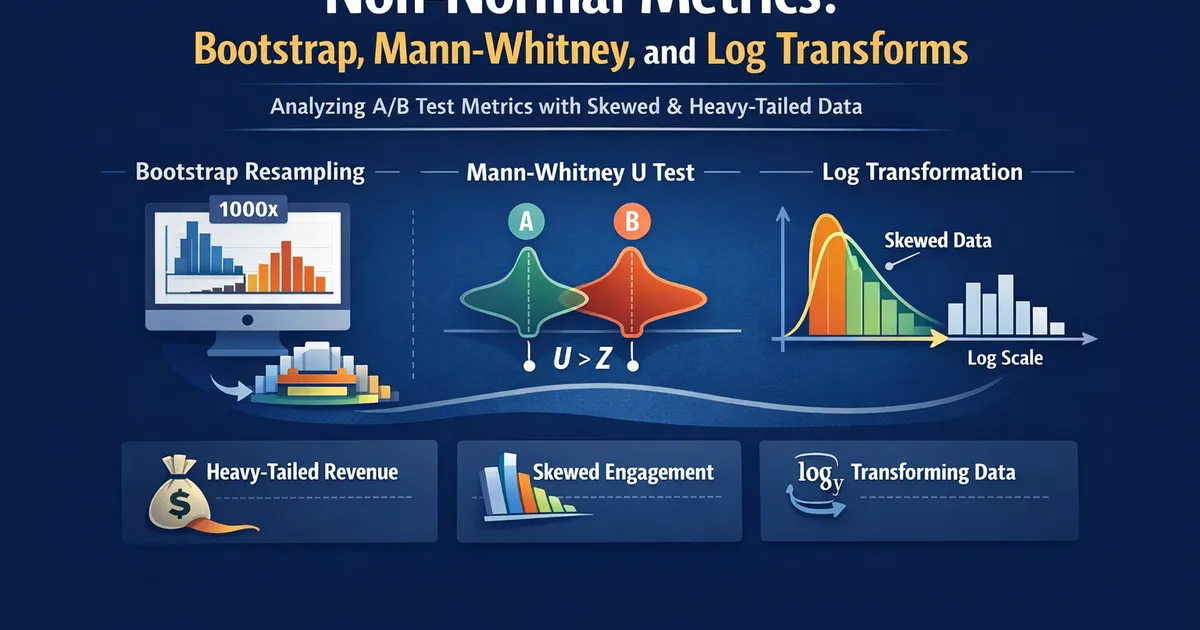
How to analyze A/B test metrics that aren't normally distributed—heavy-tailed revenue, skewed engagement, and other messy real-world data. Covers bootstrap methods, Mann-Whitney U, and when transformations help.
Quick Hits
- •The t-test is surprisingly robust—with n > 30 per group, moderate skew rarely matters
- •Bootstrap methods work for any metric and provide honest uncertainty estimates
- •Mann-Whitney tests stochastic dominance, not mean difference—know what you're testing
- •Log transforms test geometric means, which may not be the business question you want to answer
TL;DR
Product metrics are messy—revenue has whales, session times have zombies, engagement has power users. These distributions violate normality assumptions. But don't panic: t-tests are robust to moderate non-normality with large samples. When they're not enough, bootstrap methods handle anything. Mann-Whitney tests a different question (dominance, not means), and log transforms change what you're measuring. Choose based on your actual question.
When Non-Normality Matters
The Central Limit Theorem Saves You (Usually)
The t-test assumes the sampling distribution of the mean is normal. Thanks to the Central Limit Theorem, this is approximately true for large samples even when individual observations are non-normal.
Rules of thumb:
- n > 30 per group: t-test is robust to moderate skew
- n > 100 per group: t-test handles substantial skew
- n > 1000 per group: t-test works for almost anything
import numpy as np
from scipy import stats

def simulate_ttest_robustness(distribution, n_per_group, n_simulations=10000):
    """
    Simulate t-test under non-normal data to check Type I error.
    """
    significant = 0

    for _ in range(n_simulations):
        # Generate from non-normal distribution (same for both groups = null true)
        control = distribution(n_per_group)
        treatment = distribution(n_per_group)

        _, p = stats.ttest_ind(control, treatment)
        if p < 0.05:
            significant += 1

    return significant / n_simulations


# Test with exponential distribution (very skewed)
exponential = lambda n: np.random.exponential(1, n)

for n in [10, 30, 100, 1000]:
    fp_rate = simulate_ttest_robustness(exponential, n)
    print(f"n={n:4d}: False positive rate = {fp_rate:.3f} (should be ~0.05)")

# Output (typical):
# n=  10: False positive rate = 0.062 (elevated)
# n=  30: False positive rate = 0.052 (close)
# n= 100: False positive rate = 0.050 (good)
# n=1000: False positive rate = 0.050 (excellent)
When You Should Worry
- Small samples: n < 30 per group with obvious non-normality
- Extreme outliers: A few values 100x larger than typical
- Heavy tails: Distributions where extreme values dominate the mean
- Bimodal/multimodal: Distinct subpopulations in your data
Method 1: Bootstrap
Bootstrap resampling is the universal solution for non-normal data. It makes no distributional assumptions and works for any statistic.
The Idea
- Resample your data with replacement, creating many "bootstrap samples"
- Compute your statistic on each bootstrap sample
- Use the distribution of bootstrap statistics for inference
Python Implementation
import numpy as np
from scipy import stats

def bootstrap_mean_diff(control, treatment, n_bootstrap=10000, alpha=0.05):
    """
    Bootstrap confidence interval for difference in means.
    """
    diffs = []

    for _ in range(n_bootstrap):
        c_sample = np.random.choice(control, size=len(control), replace=True)
        t_sample = np.random.choice(treatment, size=len(treatment), replace=True)
        diffs.append(np.mean(t_sample) - np.mean(c_sample))

    diffs = np.array(diffs)

    # Percentile confidence interval
    ci_lower = np.percentile(diffs, 100 * alpha / 2)
    ci_upper = np.percentile(diffs, 100 * (1 - alpha / 2))

    # P-value (two-sided test of no difference)
    observed_diff = np.mean(treatment) - np.mean(control)
    # Null distribution: shift treatment to have same mean as control
    treatment_null = treatment - np.mean(treatment) + np.mean(control)

    null_diffs = []
    for _ in range(n_bootstrap):
        c_sample = np.random.choice(control, size=len(control), replace=True)
        t_sample = np.random.choice(treatment_null, size=len(treatment_null), replace=True)
        null_diffs.append(np.mean(t_sample) - np.mean(c_sample))

    null_diffs = np.array(null_diffs)
    p_value = np.mean(np.abs(null_diffs) >= np.abs(observed_diff))

    return {
        'difference': observed_diff,
        'ci_lower': ci_lower,
        'ci_upper': ci_upper,
        'p_value': p_value
    }


# Example with heavy-tailed revenue data
np.random.seed(42)
# Simulate revenue: most users spend $0-50, some spend $500+
control = np.concatenate([
    np.random.exponential(10, 900),  # Regular users
    np.random.exponential(200, 100)  # Whales
])
treatment = np.concatenate([
    np.random.exponential(11, 900),  # 10% lift for regular users
    np.random.exponential(200, 100)  # Same whales
])

result = bootstrap_mean_diff(control, treatment)
print(f"Difference: ${result['difference']:.2f}")
print(f"95% CI: [${result['ci_lower']:.2f}, ${result['ci_upper']:.2f}]")
print(f"P-value: {result['p_value']:.4f}")
R Implementation
library(boot)

# Bootstrap function for mean difference
mean_diff <- function(data, indices) {
  d <- data[indices, ]
  return(mean(d[d$group == "treatment", "value"]) -
         mean(d[d$group == "control", "value"]))
}

# Create data frame
df <- data.frame(
  value = c(control, treatment),
  group = rep(c("control", "treatment"), c(length(control), length(treatment)))
)

# Run bootstrap
boot_result <- boot(df, mean_diff, R = 10000)
boot.ci(boot_result, type = "perc")
When Bootstrap Shines
- Complex metrics: Ratios, percentiles, medians
- Heavily skewed data: Revenue, session duration
- Small samples: When CLT may not apply
- Non-standard statistics: Any function of your data
Bootstrap Limitations
- Computationally expensive: 10,000+ resamples needed
- Assumes representative sample: Garbage in, garbage out
- Doesn't fix selection bias: Bootstrap estimates uncertainty, not bias
- Heavy tails need more resamples: Rare outliers need more samples to capture
Method 2: Mann-Whitney U Test
Mann-Whitney (also called Wilcoxon rank-sum) is a non-parametric test that doesn't assume normality. But beware: it tests something different than the t-test.
What Mann-Whitney Tests
Mann-Whitney tests stochastic dominance: the probability that a randomly selected treatment observation exceeds a randomly selected control observation.
This is NOT the same as "means differ." Two groups can have:
- Same mean but different Mann-Whitney result (different shape)
- Different mean but same Mann-Whitney result (symmetric shifts)
Python Implementation
from scipy import stats

def mann_whitney_test(control, treatment):
    """
    Mann-Whitney U test for stochastic dominance.
    """
    stat, p_value = stats.mannwhitneyu(control, treatment, alternative='two-sided')

    # Probability that treatment > control
    n1, n2 = len(control), len(treatment)
    prob_treatment_greater = stat / (n1 * n2)

    return {
        'u_statistic': stat,
        'p_value': p_value,
        'prob_treatment_greater': prob_treatment_greater
    }


result = mann_whitney_test(control, treatment)
print(f"P-value: {result['p_value']:.4f}")
print(f"P(treatment > control): {result['prob_treatment_greater']:.3f}")
R Implementation
wilcox.test(treatment, control)
When to Use Mann-Whitney
- Testing whether treatment "tends to be higher" (not means)
- Ordinal data (rankings, Likert scales)
- When the business question is about typical values, not totals
- As a robustness check alongside t-test
When NOT to Use Mann-Whitney
- When you specifically care about means (use bootstrap instead)
- When you'll report effect size as mean difference
- When business impact is calculated from totals (revenue per user × users = total revenue)
Method 3: Log Transform
Log-transforming skewed data can make it more normal, enabling standard parametric tests.
What Log Transform Tests
After log transform, the t-test compares log-means. Back-transformed, this is the ratio of geometric means:
import numpy as np

# Example
values = [1, 2, 4, 8, 16]

arithmetic_mean = np.mean(values)  # 6.2
geometric_mean = np.exp(np.mean(np.log(values)))  # 4.0

print(f"Arithmetic mean: {arithmetic_mean}")
print(f"Geometric mean: {geometric_mean}")
The geometric mean is always the arithmetic mean, with equality only when all values are identical.
When Log Transform Is Appropriate
Multiplicative effects: If treatment causes a percentage change (10% lift for everyone), log-scale makes sense.
# Multiplicative effect example
control = np.random.exponential(100, 1000)
treatment = control * 1.1  # 10% lift for everyone

# Raw t-test
_, p_raw = stats.ttest_ind(control, treatment)

# Log t-test
_, p_log = stats.ttest_ind(np.log(control), np.log(treatment))

print(f"Raw p-value: {p_raw:.4f}")
print(f"Log p-value: {p_log:.4f}")
# Log test will be more powerful here
Ratio metrics: Click-through rates, conversion rates often benefit from logit transform (log-odds).
When Log Transform Is Problematic
Zeros: log(0) = -∞. Common workaround is log(x + 1), but this changes the interpretation.
# Handling zeros
values_with_zeros = [0, 0, 0, 1, 2, 5, 10, 100]

# Option 1: log(x + 1)
log_transformed = np.log(np.array(values_with_zeros) + 1)

# Option 2: Exclude zeros and analyze separately
non_zero = [v for v in values_with_zeros if v > 0]
log_non_zero = np.log(non_zero)

# Option 3: Two-part model (see related article)
Additive effects: If treatment adds a fixed amount (everyone gets $5 off), log-scale obscures this.
Business interpretation: If stakeholders need arithmetic mean (total revenue / users), log-transformed results are confusing.
Decision Framework
Is your sample large (n > 100 per group)?
├── Yes → Is the question about means?
│   ├── Yes → T-test is probably fine (robust to non-normality)
│   └── No → Use method matching your question
└── No → Are there extreme outliers or heavy tails?
    ├── Yes → Bootstrap or consider trimmed means
    └── No → T-test might still work; consider bootstrap for confirmation

What are you trying to test?
├── Mean difference → T-test or bootstrap
├── Median difference → Bootstrap or quantile regression
├── "Tends to be higher" → Mann-Whitney
├── Multiplicative effect → Log transform + t-test
└── Complex metric → Bootstrap
Practical Recommendation
For most A/B tests:
- Default: Welch's t-test (handles unequal variances, robust to moderate non-normality)
- Validate: Check histogram of your metric. Extreme skew? Run bootstrap as confirmation
- Report: If t-test and bootstrap agree, report t-test (simpler). If they disagree, investigate why and report bootstrap
Handling Outliers
Outliers disproportionately affect means. Options:
Winsorization
Cap extreme values at a percentile:
from scipy.stats import mstats

def winsorize(data, limits=(0.01, 0.01)):
    """Winsorize at 1st and 99th percentile by default."""
    return mstats.winsorize(data, limits=limits)

# Cap at 1st and 99th percentile
control_wins = winsorize(control)
treatment_wins = winsorize(treatment)
Trimmed Means
Exclude extreme values from mean calculation:
from scipy.stats import trim_mean

# 10% trimmed mean (exclude top and bottom 5%)
control_trimmed = trim_mean(control, 0.05)
treatment_trimmed = trim_mean(treatment, 0.05)

# Yuen's test for trimmed mean difference
from scipy.stats import mstats
stat, p = mstats.ttest_ind(control, treatment, trim=0.1)
When to Use
- Pre-registered rule: Decide before seeing data
- Document clearly: Report both raw and trimmed results
- Understand impact: Trimming can change your answer substantially
Related Methods
- A/B Testing Statistical Methods for Product Teams — Complete guide to A/B testing
- Why Revenue Is Hard: Log-Normal and Heavy Tails — Deep dive into revenue distributions
- Bootstrap for Heavy-Tailed Metrics — Advanced bootstrap techniques
Frequently Asked Questions
Q: Should I test for normality before choosing a method? A: Formal normality tests are nearly useless. With large samples, they reject normality for tiny deviations that don't affect inference. With small samples, they lack power to detect meaningful non-normality. Instead, look at histograms and use domain knowledge.
Q: Is median better than mean for skewed data? A: Median is more robust to outliers but answers a different question. If business impact is calculated from totals (mean users), you need mean. Median tells you about the typical user.
Q: Can I use both t-test and Mann-Whitney? A: Yes, as a robustness check. If they give different conclusions, investigate why (likely different questions being answered or extreme outliers affecting the mean).
Q: How many bootstrap resamples do I need? A: 10,000 is standard for confidence intervals, 1,000 might suffice for point estimates. For p-values, use at least 10,000.
Key Takeaway
For most A/B tests with reasonable sample sizes, the t-test works fine despite non-normality. When it doesn't—small samples, extreme skew, or outliers—bootstrap is your Swiss Army knife. It handles any metric and gives honest confidence intervals. Use Mann-Whitney only when testing "tends to be higher" (stochastic dominance) rather than mean difference. And remember: log transforms change what you're testing.
References
- https://www.jstor.org/stable/2684360
- https://www.stat.berkeley.edu/~census/bootstrap.pdf
- Efron, B., & Tibshirani, R. J. (1993). *An Introduction to the Bootstrap*. Chapman & Hall/CRC.
- Lumley, T., Diehr, P., Emerson, S., & Chen, L. (2002). The importance of the normality assumption in large public health data sets. *Annual Review of Public Health*, 23(1), 151-169.
- Mann, H. B., & Whitney, D. R. (1947). On a test of whether one of two random variables is stochastically larger than the other. *The Annals of Mathematical Statistics*, 18(1), 50-60.
Frequently Asked Questions
When does non-normality actually matter?
Should I always log-transform revenue?
Is bootstrap always better than parametric tests?
Key Takeaway
For most A/B tests with reasonable sample sizes, the t-test works fine despite non-normality. When it doesn't, bootstrap is your Swiss Army knife—it handles any metric and gives honest confidence intervals. Use Mann-Whitney when you want to test 'tends to be higher' rather than 'mean is higher.'