Contents
Welch's ANOVA: When Group Variances Differ
Welch's ANOVA handles unequal variances across groups without requiring the homogeneity assumption. Learn when to use it instead of standard one-way ANOVA and how to follow up.
Quick Hits
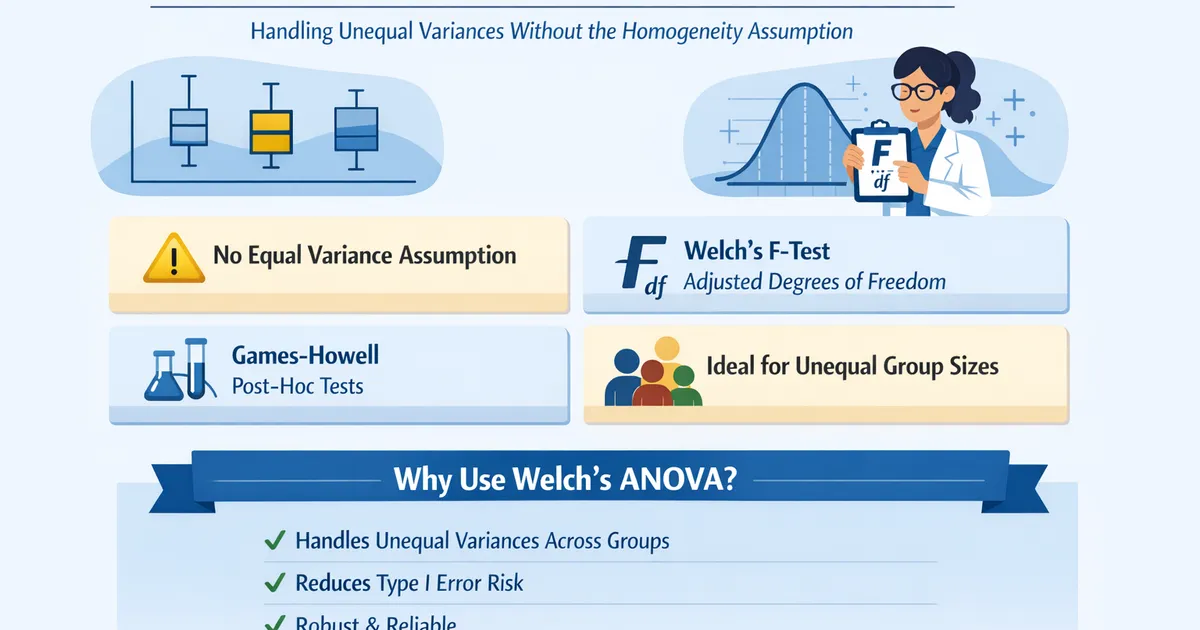
- •Does not assume equal variances across groups (unlike standard ANOVA)
- •Uses Welch's F-test with adjusted degrees of freedom
- •Recommended as the default by many statisticians — it works fine even when variances ARE equal
- •Follow up with Games-Howell post-hoc tests (also variance-robust)
- •Especially important with unequal group sizes
When group variances are unequal, the standard One-Way ANOVA can produce inflated Type I error rates, especially with unequal group sizes. Welch's ANOVA solves this problem.
How Welch's ANOVA Differs
Standard ANOVA pools variances across groups and assumes they are equal. Welch's ANOVA:
- Does not pool variances: Each group keeps its own variance estimate
- Adjusts degrees of freedom: Uses the Welch-Satterthwaite approximation to reduce degrees of freedom when variances differ
- Protects Type I error: Maintains the nominal significance level even with heteroskedastic data
The result is an F-statistic and p-value, interpreted exactly like standard ANOVA.
When Unequal Variances Matter Most
The combination of unequal variances AND unequal group sizes is especially problematic:
- Larger variance in the smaller group: Standard ANOVA becomes liberal (too many false positives)
- Larger variance in the larger group: Standard ANOVA becomes conservative (misses real effects)
Welch's ANOVA handles both scenarios correctly.
Post-Hoc Comparisons
After a significant Welch's ANOVA, use Games-Howell post-hoc tests for pairwise comparisons. These also do not assume equal variances and pair naturally with Welch's approach.
Do NOT use Tukey HSD after Welch's ANOVA — Tukey assumes equal variances.
Example
You compare engagement scores across three pricing tiers: Free (n=500, SD=12.1), Pro (n=150, SD=8.3), Enterprise (n=40, SD=19.7).
Levene's test rejects equal variances (p < 0.001). Standard ANOVA might give misleading results because the smallest group (Enterprise) has the largest variance.
Welch's ANOVA: F(2, 87.4) = 15.2, p < 0.001. The adjusted degrees of freedom (87.4 instead of 687) reflect the uncertainty from unequal variances. Games-Howell post-hoc tests identify which pairs differ.
See also: Heteroskedastic Groups: When Variances Differ for more on handling unequal variances.
References
- https://www.ncbi.nlm.nih.gov/pmc/articles/PMC3693611/
- https://real-statistics.com/one-way-analysis-of-variance-anova/welchs-anova/
Frequently Asked Questions
Should I always use Welch's ANOVA instead of standard ANOVA?
What post-hoc test should I use with Welch's ANOVA?
How do I detect unequal variances?
Key Takeaway
Welch's ANOVA is a robust alternative to one-way ANOVA that does not require equal variances across groups. It is increasingly recommended as the default choice because it protects against variance heterogeneity without meaningfully sacrificing power when variances are equal.