Contents
Mood's Median Test: Comparing Medians Without Distributional Assumptions
Mood's median test compares medians across two or more groups with minimal assumptions. Learn when it beats Mann-Whitney, its limitations, and better alternatives.
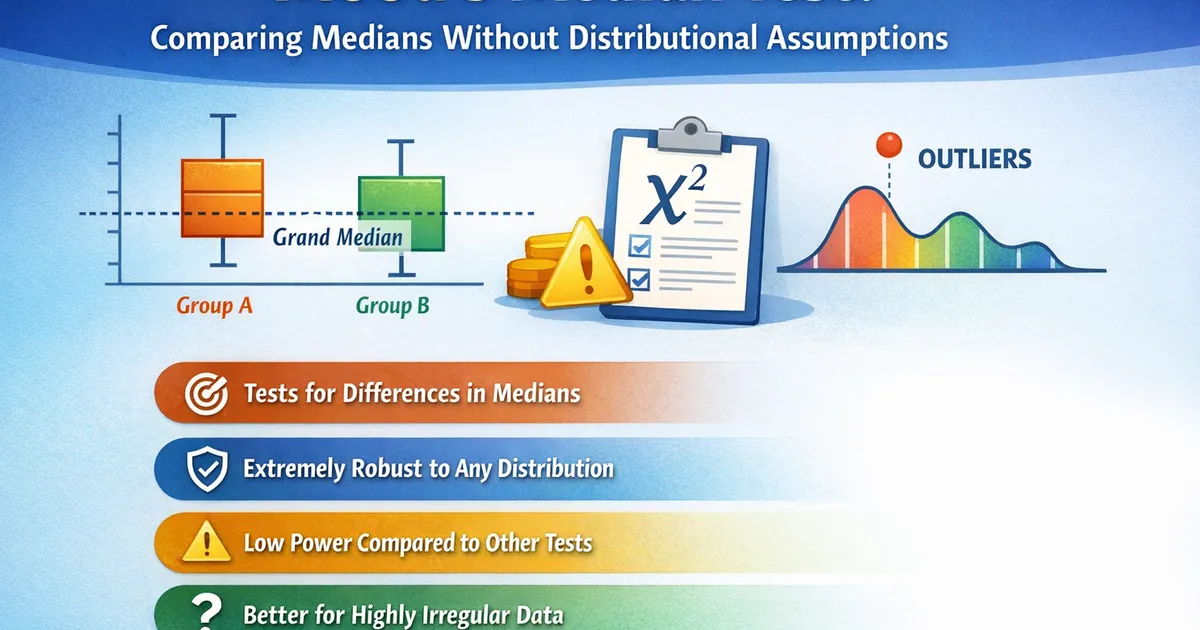
Quick Hits
- •Tests whether two or more groups have the same median
- •Extremely robust: works with any distribution shape
- •Low power compared to Mann-Whitney or the t-test
- •Converts data to above/below grand median, then uses chi-square
- •Best for very non-standard distributions where other tests fail
Mood's median test is the simplest and most robust non-parametric test for comparing group medians. It works by converting all observations to a binary indicator (above or below the grand median) and then applying a chi-square test.
How It Works
- Compute the grand median of all observations pooled across groups
- For each group, count how many observations are above and below the grand median
- Arrange counts in a contingency table
- Apply a chi-square test (or Fisher's exact test for small samples)
If the groups have the same median, you expect roughly equal proportions above and below in each group.
When to Use It
- Extreme outliers are present that distort rank-based tests
- Very non-standard distributions where even Mann-Whitney U assumptions (similar shapes) are questionable
- Quick robustness check to see if a finding holds under the weakest possible assumptions
Limitations
The main limitation is low statistical power. By reducing each observation to a binary indicator, Mood's median test throws away most of the information in the data. In head-to-head comparisons:
| Test | Power | Robustness | Assumptions |
|---|---|---|---|
| T-test | Highest | Lowest | Normality, equal variance |
| Mann-Whitney | High | High | Similar shapes |
| Mood's Median | Lowest | Highest | None |
For most practical situations, Mann-Whitney U or Kruskal-Wallis provides the best balance.
See also: Comparing Medians: Statistical Tests and Better Options for a broader discussion of median comparison approaches.
References
- https://www.itl.nist.gov/div898/software/dataplot/refman2/auxillar/meditest.htm
- https://real-statistics.com/non-parametric-tests/median-test/
Frequently Asked Questions
When should I use Mood's median test instead of Mann-Whitney?
Can I use Mood's median test with more than two groups?
Why is Mood's median test less powerful?
Key Takeaway
Mood's median test is the most robust group comparison test available, but also the least powerful. Use it as a last resort when extreme outliers or bizarre distributions make other non-parametric tests unreliable. For most situations, Mann-Whitney or Kruskal-Wallis provides a better balance of robustness and power.