Contents
Forecasting Product Metrics: ARIMA, Prophet, and When Simple Wins
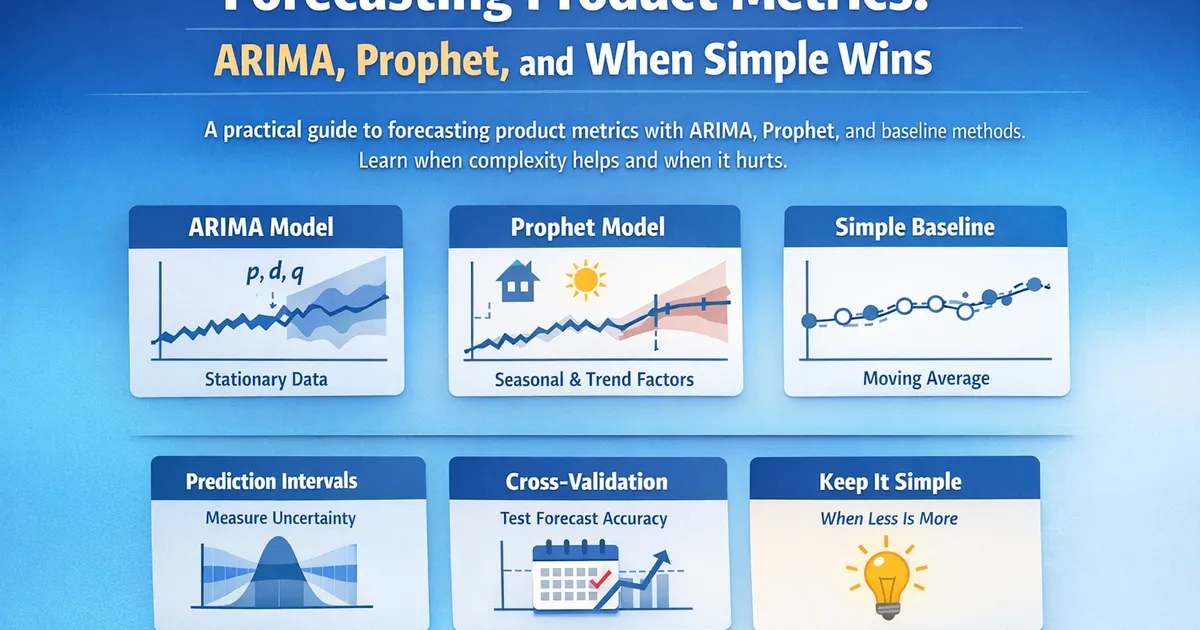
A practical guide to forecasting product metrics with ARIMA, Prophet, and baseline methods. Learn when complexity helps and when it hurts.
Quick Hits
- •Simple baselines (seasonal naive, moving averages) beat complex models more often than you'd expect
- •ARIMA excels with stationary data after differencing -- use auto_arima to select parameters
- •Prophet handles multiple seasonalities, holidays, and changepoints with minimal tuning
- •Always evaluate forecasts with proper time series cross-validation -- never use random splits
- •Prediction intervals matter more than point forecasts for product decisions
TL;DR
Product teams need forecasts for capacity planning, goal setting, anomaly detection, and resource allocation. This guide covers the practical forecasting toolkit: simple baselines that are surprisingly hard to beat, ARIMA for stationary patterns, Prophet for complex seasonality, and how to evaluate which method actually works for your data. The core lesson: always start simple, validate rigorously, and report uncertainty.
Why Forecast Product Metrics?
Forecasting serves four main purposes in product analytics:
- Anomaly detection: A forecast defines "expected." Deviations from expected are anomalies worth investigating. See our overview of time series analysis for product metrics.
- Goal setting: Realistic targets come from projecting current trajectories with uncertainty bounds.
- Capacity planning: Infrastructure, support staffing, and inventory decisions require estimates of future demand.
- Impact estimation: Comparing actual post-launch metrics to forecasted counterfactuals estimates causal impact (see interrupted time series).
Start Simple: Baseline Methods
Seasonal Naive
The seasonal naive forecast predicts next week using this week's values: next Monday = this Monday, next Tuesday = this Tuesday, and so on.
# Seasonal naive: use last week's values
def seasonal_naive(data, period=7, horizon=7):
    return data[-period:(-period + horizon)]
This method captures weekly seasonality perfectly and requires zero parameters. It is your minimum bar -- any method that cannot beat seasonal naive is not worth the complexity.
Moving Average
Average the last periods to smooth out noise:
def moving_average(data, window=28):
    return data[-window:].mean()
Moving averages are simple, interpretable, and provide a steady baseline. They lag behind trends but handle noise well.
Exponential Smoothing (ETS)
ETS is a family of methods that weight recent observations more heavily than older ones. The Holt-Winters variant handles trend and seasonality.
from statsmodels.tsa.holtwinters import ExponentialSmoothing

model = ExponentialSmoothing(
    daily_dau,
    trend='add',
    seasonal='add',
    seasonal_periods=7
).fit()

forecast = model.forecast(steps=14)
ETS is often the best balance of simplicity and accuracy for product metrics. It adapts to level changes, captures trends, and models seasonality -- all with a handful of parameters.
ARIMA: The Classical Workhorse
Core Concept
ARIMA (AutoRegressive Integrated Moving Average) models the metric as a function of its own past values (AR), past forecast errors (MA), and differencing (I) to achieve stationarity.
ARIMA(, , ):
- : Number of autoregressive terms (how many past values to use)
- : Degree of differencing (how many times to difference for stationarity)
- : Number of moving average terms (how many past errors to use)
When to Use ARIMA
ARIMA works well when:
- The data is (or can be made) stationary through differencing
- Autocorrelation patterns are clear in the ACF/PACF
- You have enough data (50+ observations minimum, 100+ preferred)
Auto-ARIMA: Let the Algorithm Choose
Manual ARIMA order selection (examining ACF/PACF plots to choose , , ) is an art. Auto-ARIMA automates this using information criteria (AIC/BIC):
from pmdarima import auto_arima

model = auto_arima(
    daily_dau,
    seasonal=True,
    m=7,  # weekly seasonality
    stepwise=True,
    suppress_warnings=True,
    error_action="ignore"
)

print(model.summary())
forecast, conf_int = model.predict(
    n_periods=14,
    return_conf_int=True
)
Auto-ARIMA searches through combinations of (, , ) and seasonal (, , , ) parameters, selecting the model that minimizes AIC. This is the recommended approach for practitioners.
SARIMA: Adding Seasonality
SARIMA extends ARIMA with seasonal terms: ARIMA(, , )(, , ), where is the seasonal period. For daily data with weekly seasonality, .
The seasonal components capture patterns that repeat every periods (e.g., the Monday effect, the weekend dip). Auto-ARIMA handles seasonal selection automatically when you specify .
Prophet: Designed for Business Metrics
Why Prophet?
Facebook's Prophet was built specifically for business time series forecasting. It handles:
- Multiple seasonalities: Weekly, monthly, and annual simultaneously
- Holiday effects: Specify holiday dates and Prophet models their impact
- Changepoints: Automatic detection of trend changes
- Missing data: Handles gaps without imputation
- Outliers: Robust fitting reduces outlier influence
Implementation
from prophet import Prophet

# Prepare data in Prophet format
df = pd.DataFrame({
    'ds': dates,
    'y': daily_dau
})

model = Prophet(
    yearly_seasonality=True,
    weekly_seasonality=True,
    daily_seasonality=False,
    changepoint_prior_scale=0.05  # regularize changepoints
)

# Add holidays
model.add_country_holidays(country_name='US')

model.fit(df)

# Forecast 14 days
future = model.make_future_dataframe(periods=14)
forecast = model.predict(future)
Prophet's Strengths and Weaknesses
Strengths:
- Minimal tuning required for reasonable forecasts
- Handles multiple seasonalities natively
- Built-in holiday modeling
- Interpretable components (trend, weekly, yearly, holidays)
- Scales to many time series
Weaknesses:
- Can overfit with too many changepoints (reduce
changepoint_prior_scale) - Does not model autocorrelation in residuals (unlike ARIMA)
- Less flexible than ARIMA for short-term, high-frequency patterns
- Assumes additive or multiplicative seasonality (not a mix)
When to Choose Prophet Over ARIMA
- Multiple seasonal periods (weekly + annual): Prophet handles this natively; ARIMA requires nested seasonal terms
- Holiday effects: Prophet models them directly; ARIMA needs manual dummy variables
- Non-technical users: Prophet requires less statistical knowledge
- Many time series: Prophet's defaults work reasonably across different metrics
Model Evaluation: Time Series Cross-Validation
Why Standard Cross-Validation Fails
Random train/test splits violate temporal order -- you would train on future data and predict the past. Time series cross-validation uses expanding or rolling windows that always train on past data and evaluate on future data.
from sklearn.model_selection import TimeSeriesSplit

tscv = TimeSeriesSplit(n_splits=5)
for train_idx, test_idx in tscv.split(data):
    train, test = data[train_idx], data[test_idx]
    # Fit on train, evaluate on test
Key Metrics
MAE (Mean Absolute Error): Average absolute forecast error. Interpretable in the metric's units.
MAPE (Mean Absolute Percentage Error): MAE as a percentage of actual values. Useful for comparing across metrics with different scales, but undefined when actuals are zero.
RMSE (Root Mean Squared Error): Penalizes large errors more than MAE. Use when big misses are disproportionately costly.
Coverage: What percentage of actual values fall within the prediction interval? For 95% intervals, coverage should be near 95%. If it is 80%, your intervals are too narrow.
Comparing Models
results = {}
for name, model_fn in models.items():
    errors = []
    for train_idx, test_idx in tscv.split(data):
        train, test = data[train_idx], data[test_idx]
        forecast = model_fn(train, len(test))
        errors.append(np.mean(np.abs(test - forecast)))
    results[name] = np.mean(errors)

# Choose the model with lowest average MAE
best_model = min(results, key=results.get)
Always include the seasonal naive baseline. If your sophisticated model cannot beat it, either the data lacks predictable structure or your model is misconfigured.
Prediction Intervals: The Honest Part
Point forecasts are nearly always wrong. Prediction intervals convey the uncertainty that decision-makers need.
A 95% prediction interval should contain the actual future value 95% of the time. If your intervals are too narrow (low coverage), your model is overconfident. If too wide, the forecast is not useful.
For capacity planning: use the upper bound of the prediction interval. For goal setting: use the point forecast with the interval as context. For anomaly detection: flag observations outside the interval.
When Simple Wins
Simple methods win when:
- The time series is short (< 50 observations): Complex models overfit
- The metric is noisy with weak patterns: No model can predict randomness
- The forecast horizon is very short (1-2 periods): Recent values dominate
- You need interpretability: Explaining "we used last week's values" is easier than "our SARIMA(1,1,1)(0,1,1)7 model indicates..."
- Speed matters: Simple methods compute in milliseconds
Start simple. Add complexity only when cross-validation shows measurable improvement. Document your comparison so stakeholders trust the choice.
References
- https://otexts.com/fpp3/
- https://facebook.github.io/prophet/docs/quick_start.html
- https://alkaline-ml.com/pmdarima/
- Hyndman, R. J., & Athanasopoulos, G. (2021). *Forecasting: Principles and Practice*, 3rd edition. OTexts.
- Taylor, S. J., & Letham, B. (2018). Forecasting at scale. *The American Statistician*, 72(1), 37-45.
Frequently Asked Questions
Which forecasting method should I start with?
How far ahead can I reliably forecast product metrics?
Why are my forecast prediction intervals so wide?
Key Takeaway
Forecasting product metrics is about choosing the right complexity level. Simple methods (seasonal naive, ETS) are surprisingly strong baselines. ARIMA handles stationary patterns well after differencing. Prophet excels with multiple seasonalities, holidays, and changepoints. Always validate with time series cross-validation, always report prediction intervals, and never assume a complex model is better until you prove it out-of-sample.