Contents
Time Series Analysis for Product Metrics: Trends, Seasonality, and Anomalies
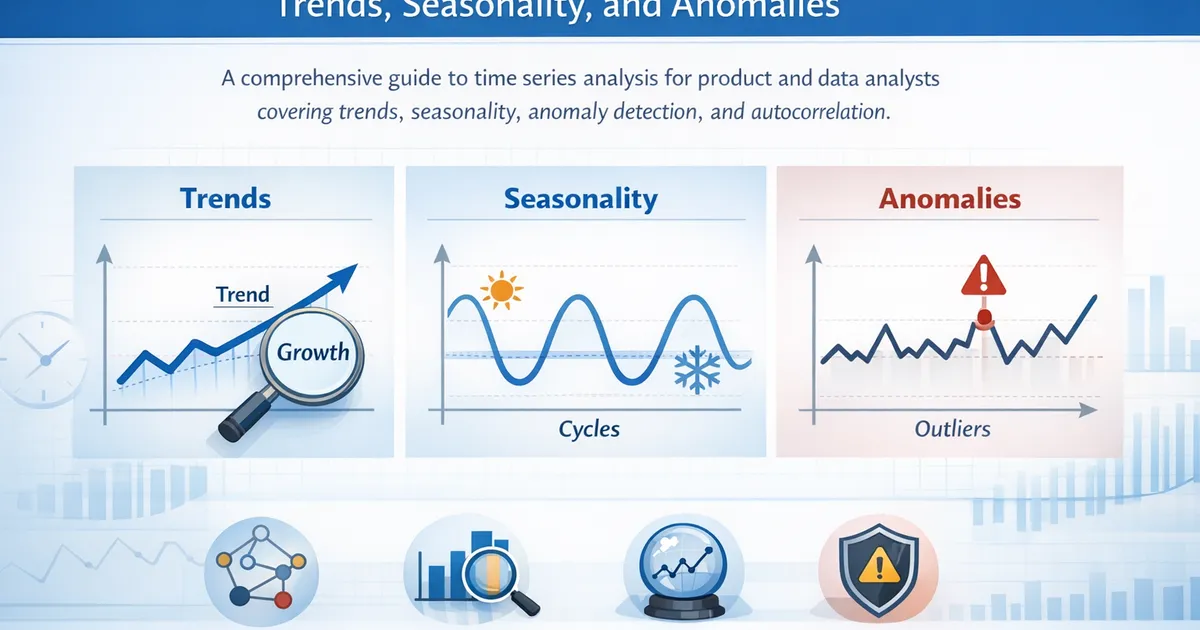
A comprehensive guide to time series analysis for product and data analysts covering trends, seasonality, anomaly detection, and autocorrelation.
Quick Hits
- •Product metrics are time series data -- ignoring temporal structure leads to false conclusions
- •Decompose any metric into trend, seasonal, and residual components before drawing insights
- •Autocorrelation means consecutive data points are not independent, invalidating many standard tests
- •Anomaly detection requires understanding what 'normal' looks like first -- build a baseline
- •Most product metric shifts are calendar effects, not real changes -- always check for seasonality
TL;DR
Product metrics -- DAU, revenue, conversion rates, engagement scores -- are time series data. They have trends, seasonal patterns, and autocorrelation that most standard statistical tests ignore. This guide covers the essential time series concepts every product analyst needs: how to decompose metrics into their components, why autocorrelation matters for your analyses, how to detect genuine anomalies versus calendar noise, and when to use which time series method. If you only learn one thing: never analyze a product metric without first understanding its temporal structure.
Why Product Metrics Have Time Structure
Every product metric you track lives on a timeline. Daily active users on Monday behave differently from Saturday. Revenue spikes during holidays. Engagement gradually climbs after an onboarding redesign. These are not random fluctuations -- they are systematic temporal patterns that carry information.
The three fundamental components of any product metric time series are:
Trend: The long-term direction. Is DAU gradually increasing, flat, or declining? Trends can be linear or nonlinear, and they often reflect the underlying health of your product.
Seasonality: Repeating patterns at fixed intervals. Weekly cycles (weekday vs. weekend), monthly cycles (paycheck timing), and annual cycles (holidays, back-to-school) all show up in product data. A metric that looks volatile might be perfectly predictable once you account for its seasonal pattern.
Residual (Irregular Component): What remains after removing trend and seasonality. This is where genuine anomalies, A/B test effects, and random noise live. The goal of decomposition is to isolate this component so you can focus on what actually changed.
Ignoring this structure is the single most common mistake in product analytics. When you compare this Tuesday to last Monday without accounting for day-of-week effects, you are mixing signal with seasonal noise. When you run a t-test on daily metrics without addressing autocorrelation, your p-values are wrong.
Autocorrelation: The Hidden Problem
Autocorrelation means that today's metric value is correlated with yesterday's (and the day before, and the day before that). This is nearly universal in product data: if DAU is high today, it is probably high tomorrow too.
Why does this matter? Most standard statistical tests assume independence between observations. When your data points are autocorrelated, these tests underestimate variance, producing confidence intervals that are too narrow and p-values that are too small. You will see "significant" results that are actually just noise.
The autocorrelation function (ACF) plot is your diagnostic tool. It shows the correlation between a metric and its lagged values. A slowly decaying ACF suggests a trend. Spikes at regular intervals (lag 7, 14, 21) indicate weekly seasonality. If any lags exceed the significance bands, your data is autocorrelated and you need time-series-aware methods.
For a deeper dive into autocorrelation and what to do about it, see our guide on autocorrelation in daily metrics.
Seasonal Decomposition: Seeing the Components
Decomposition separates your metric into trend, seasonal, and residual components. There are two main approaches:
Additive decomposition: . Use when seasonal swings are roughly constant regardless of the metric level.
Multiplicative decomposition: . Use when seasonal swings grow proportionally with the metric (e.g., holiday revenue spikes are larger as your business grows).
STL (Seasonal and Trend decomposition using LOESS) is the modern workhorse. It handles additive decomposition robustly, adapts to changing seasonality, and is resistant to outliers. For most product metrics, STL is your starting point.
from statsmodels.tsa.seasonal import STL

# Decompose daily DAU with weekly seasonality
stl = STL(daily_dau, period=7, robust=True)
result = stl.fit()

# Now examine components separately
trend = result.trend
seasonal = result.seasonal
residual = result.resid
After decomposition, examine each component:
- Trend: Is it going up, down, or flat? Is the direction changing?
- Seasonal: What is the weekly/monthly pattern? Is it stable?
- Residual: Are there outliers? These are your genuine anomalies.
For a complete treatment of decomposition methods and handling calendar effects, see seasonal decomposition.
Trend Detection: Separating Real Movement from Noise
Not every upward-looking line on a chart is a real trend. Random walks can look like trends. Seasonality can masquerade as trends. You need formal methods to distinguish genuine directional movement from noise.
The Mann-Kendall test is the standard non-parametric trend test. It asks: is there a monotonic trend in the data? It does not assume linearity or normality, making it robust for product metrics. It returns a p-value for trend significance and Kendall's tau for trend strength.
LOESS smoothing provides a visual and quantitative trend estimate. By fitting local regressions, LOESS reveals nonlinear trends that linear methods miss. This is especially useful when a metric accelerates or decelerates.
Change point detection identifies moments when the statistical properties of a metric shifted. Unlike trend tests (which look for gradual movement), change point methods find abrupt shifts -- exactly what you need to detect the impact of a product launch, an algorithm change, or an external event.
These methods complement each other: use Mann-Kendall to confirm a trend exists, LOESS to visualize its shape, and change point detection to identify when shifts occurred. For detailed methodology, see our guides on trend detection methods and change point detection.
Anomaly Detection: Finding What Actually Changed
Anomaly detection in product metrics is not about finding outliers in a static dataset. It is about finding data points that deviate from the expected temporal pattern. A value that looks extreme in isolation might be perfectly normal for a holiday weekend.
Effective anomaly detection requires a baseline model that captures trend and seasonality. Residuals from this model represent deviations from "normal." Points where residuals exceed a threshold (typically 2-3 standard deviations, or a prediction interval) are flagged as anomalies.
Practical approach for product teams:
- Build a baseline: Decompose the metric using STL or a forecasting model like Prophet or ARIMA.
- Compute prediction intervals: These define the range of "expected" values.
- Flag deviations: Points outside the prediction interval are candidate anomalies.
- Investigate, don't auto-alert: Context matters. A flagged anomaly on Black Friday is expected; on a random Wednesday, it warrants investigation.
The challenge is balancing sensitivity and specificity. Too sensitive, and your team gets alert fatigue. Too conservative, and you miss real problems. Start conservative and tune based on how many alerts lead to actionable findings.
Common Pitfalls in Time Series Analysis of Product Metrics
Comparing Unadjusted Periods
Comparing January to December without seasonal adjustment is meaningless for most products. Always compare like-for-like (same day of week, same seasonal period) or use seasonally adjusted values.
Ignoring Autocorrelation in A/B Tests
If your A/B test runs on daily aggregated metrics and you analyze the daily data points as independent, your standard errors are too small. Either aggregate to one number per variant, use time-series-aware models, or apply corrections like Newey-West standard errors.
Confusing Correlation with Causation in Time Series
Two metrics can be correlated over time simply because they both have trends. This is spurious correlation. Before claiming that feature adoption drives retention, you need methods like Granger causality or interrupted time series that account for temporal structure.
Overfitting with Too Many Parameters
Forecasting models with too many seasonal terms, holidays, and regressors will fit historical data perfectly but predict poorly. Cross-validation on time series data requires special care -- never use future data to predict the past (use rolling or expanding window validation).
Ignoring Structural Breaks
A model trained on data from before a major product change will produce misleading forecasts and anomaly flags afterward. When your product fundamentally changes, your baseline model needs to change too.
When to Use Which Method
| Question | Method | Guide |
|---|---|---|
| Is there a trend? | Mann-Kendall, LOESS | Trend Detection |
| Are my data points independent? | ACF, Ljung-Box test | Autocorrelation |
| What's the seasonal pattern? | STL, classical decomposition | Seasonal Decomposition |
| When did the metric shift? | PELT, BOCPD, CUSUM | Change Point Detection |
| What will the metric be next week? | ARIMA, Prophet, ETS | Forecasting |
| Did this launch cause the change? | ITS, DiD | Interrupted Time Series |
| Does X drive Y over time? | Granger causality, VAR | Granger Causality |
| Is pre/post different across groups? | Difference-in-Differences | DiD for Product |
Getting Started
If you are new to time series analysis of product metrics, start with these steps:
- Plot the raw data over at least a few months. Look for obvious trends, weekly patterns, and outliers.
- Check autocorrelation with an ACF plot. If significant lags exist, standard tests are unreliable.
- Decompose using STL with the appropriate period (7 for daily data with weekly seasonality).
- Examine residuals. Are they roughly random, or do patterns remain?
- Apply the right method for your question using the table above.
Time series analysis is not optional for product analytics -- it is foundational. Every metric your team monitors has temporal structure, and ignoring it means drawing conclusions from noise. The tools are accessible, the methods are well-established, and the payoff is analyses your stakeholders can actually trust.
References
- https://otexts.com/fpp3/
- https://www.itl.nist.gov/div898/handbook/pmc/section4/pmc4.htm
- https://facebook.github.io/prophet/docs/quick_start.html
- Hyndman, R.J., & Athanasopoulos, G. (2021). *Forecasting: Principles and Practice*, 3rd edition. OTexts.
- Cleveland, R. B., Cleveland, W. S., McRae, J. E., & Terpenning, I. (1990). STL: A seasonal-trend decomposition. *Journal of Official Statistics*, 6(1), 3-73.
Frequently Asked Questions
Why can't I just compare this week's metric to last week?
How much historical data do I need for time series analysis?
What's the difference between a trend and a level shift?
Key Takeaway
Product metrics are inherently time series data with trends, seasonality, and autocorrelation. Ignoring this temporal structure leads to false alarms, missed real changes, and flawed A/B test conclusions. Decompose your metrics, check for autocorrelation, and use time-series-aware methods to separate genuine shifts from calendar noise.