Contents
Testing Distribution Assumptions
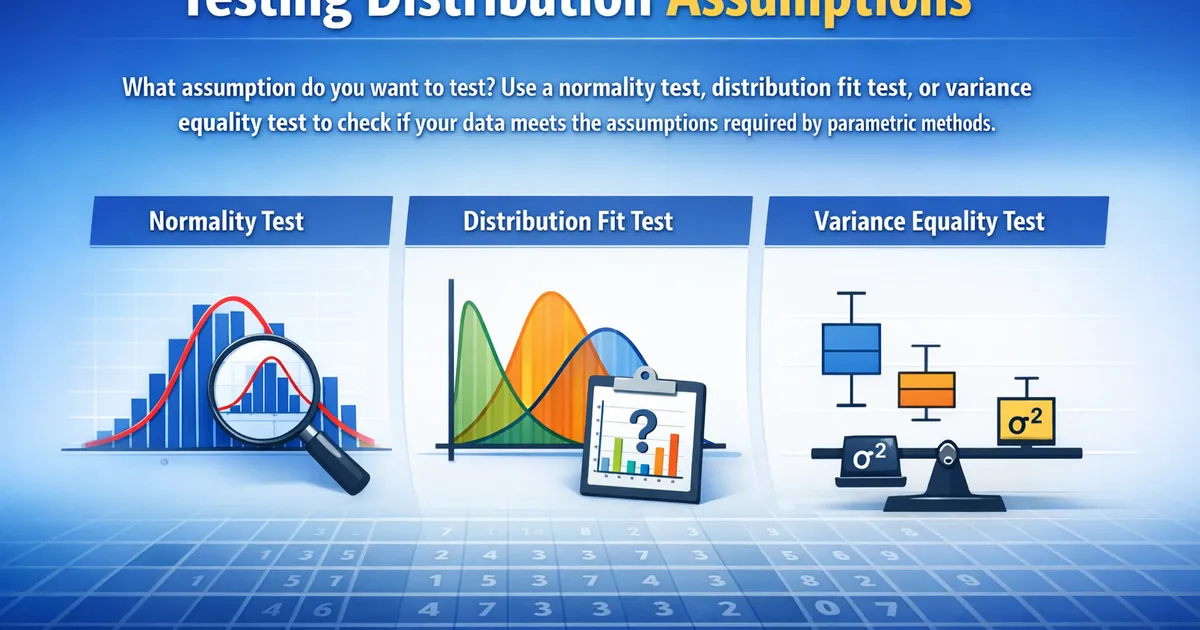
What assumption do you want to test? Use a normality test, distribution fit test, or variance equality test to check whether your data meets the assumptions required by parametric methods.
What assumption are you testing?
Is my data normally distributed?
- OR -
Does my data follow a specific distribution?
- OR -
Do my groups have equal variance?
More Information (if you need help deciding)
Is my data normally distributed? Use the Shapiro-Wilk Test to formally test whether your sample comes from a normal distribution. This is useful before running parametric tests like the t-test or ANOVA that assume normality. The Shapiro-Wilk test is the most powerful normality test for small to moderate samples.
Does my data follow a specific distribution? Use the Kolmogorov-Smirnov Test to test whether your data follows any specified continuous distribution (not just normal). The two-sample variant also lets you compare two empirical distributions to check for drift or differences. It is the most flexible goodness-of-fit test available.
Do my groups have equal variance? Use Levene's Test to check whether the variances of your outcome variable are similar across groups. This is the homogeneity of variance assumption required by standard ANOVA and the pooled t-test. If violated, use Welch's variants instead.